Backflow preventer test and install in Evansville, IN
On Evansville city water, the City and the State of Indiana require backflow devices to be installed and then tested every year. Evansville Water and Sewer Utility (EWSU) runs that program with Aqua Backflow. Backflow preventer test and install comes up when a test notice arrives in the mail, a device drips beside the sprinkler valve, or a new irrigation system is in the plans. What you need depends on the device: is there one yet, did it pass, and what does it protect?
Who Requires Backflow Testing Every Year
If an EWSU or Aqua Backflow notice says your backflow device is due, the backflow testing requirement comes from two places at once. Evansville's municipal code (EMC 13.15) says customers must test and service required devices every year and keep the records for EWSU. Indiana rule 327 IAC 8-10 requires a test when a device is installed and at least once a year after that.
EWSU lists where homes usually have one: lawn sprinkler or irrigation systems, wet fire-protection lines, hot-water boiler systems, swimming pools, and water features. Businesses add more, and Indiana's plumbing code treats the backflow preventer on a carbonated beverage machine as high hazard rather than low.
The property owner carries the duty. EWSU says that you, as the owner, are responsible for the yearly steps, and Evansville code lets the water purveyor discontinue service to a property whose required device is not installed, tested, and maintained. For a rental or a leased storefront, the lease may hand the task to the tenant.
Who may run the test matters as much as when. Under 327 IAC 8-10-1, the tester must be a cross connection control device inspector holding a registration number from the Indiana Department of Environmental Management (IDEM). Ask any tester for that IDEM registration number before work starts, whoever you hire.
A legitimate notice may carry EWSU's name or Aqua Backflow's, since the two run the program together. When a letter or flyer looks official but you can't tell who sent it, check with EWSU at the number on your water bill before paying anyone.
How Backflow Testing Works, and What a Fail Means
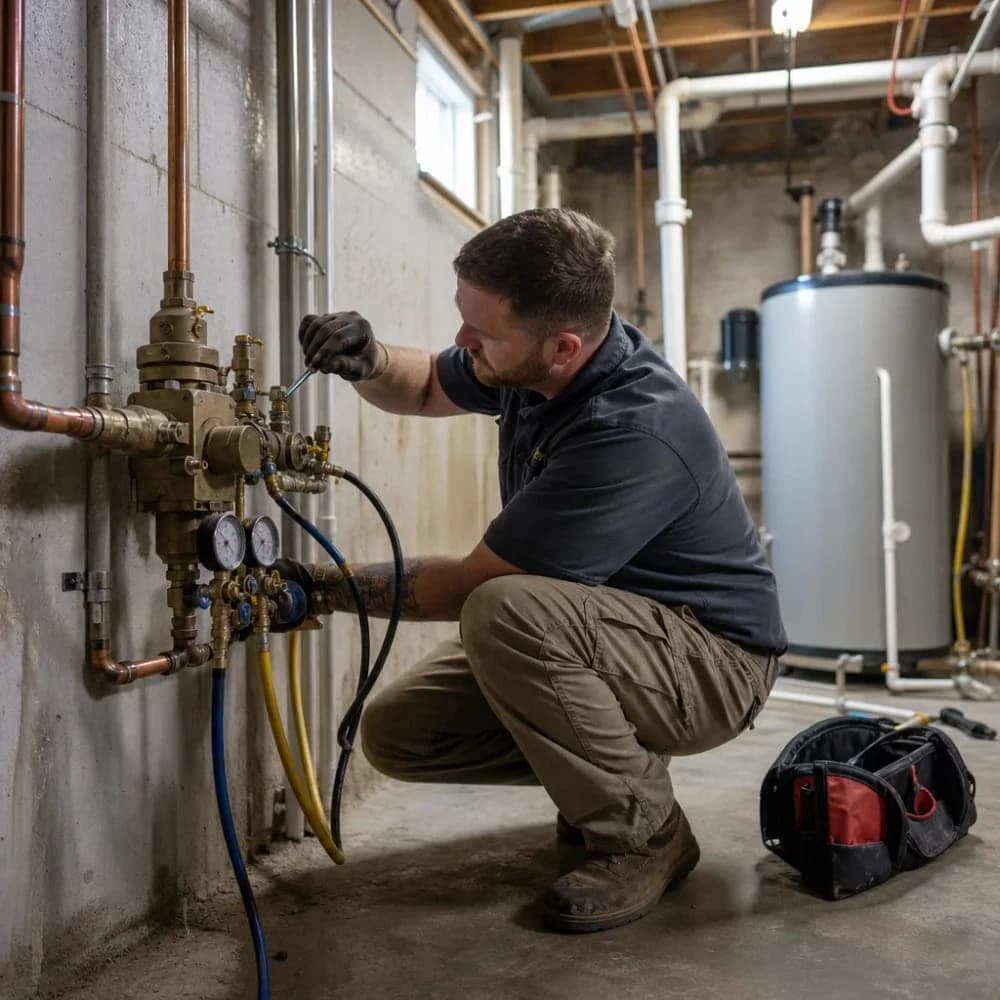
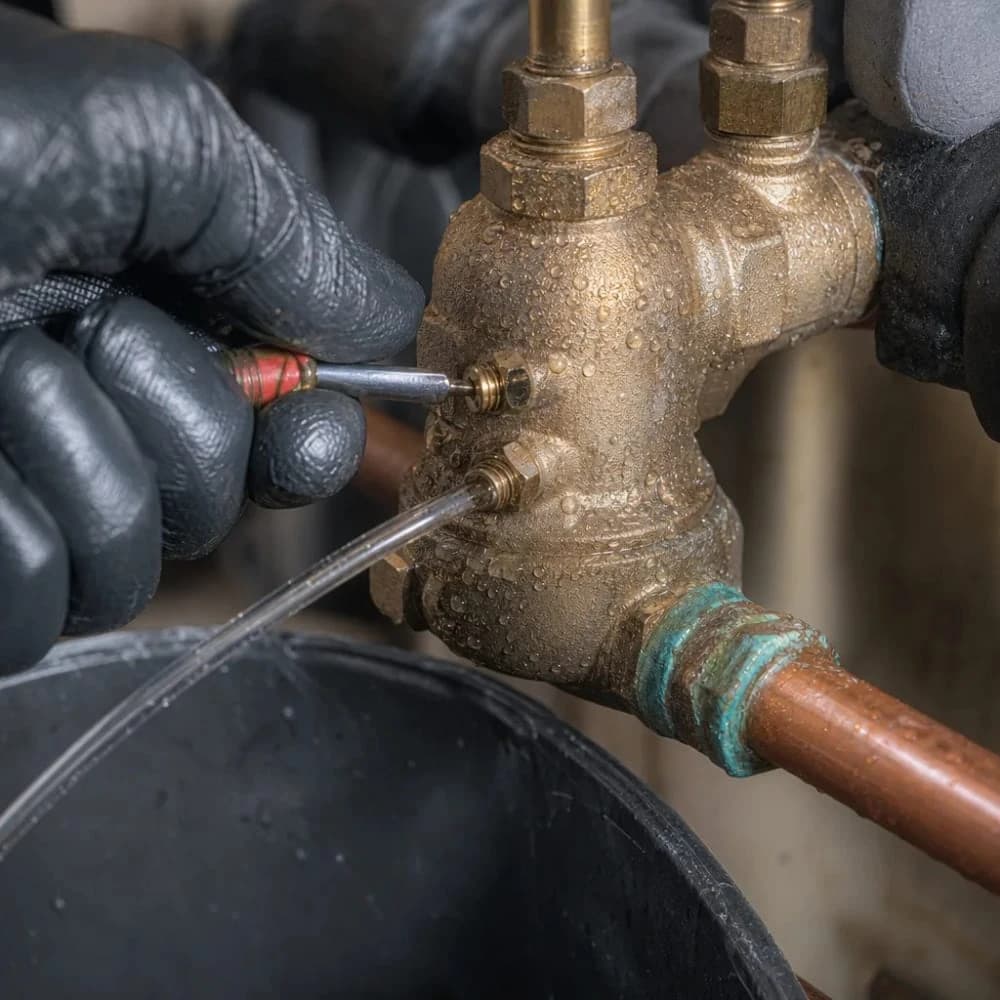
When the notice date is close and the device isn't dripping from its relief port, backflow testing is a short visit. The tester shuts the water to the device, connects a gauge kit to its test ports, and checks that each check valve closes tight and, on a reduced pressure (RPZ) assembly, that the relief valve opens when it should.
On a sprinkler line, only the irrigation side goes dry during the test. On a building's main service line, every fixture past the device loses water until the gauge work is done, so restaurants and offices usually plan for a slow hour.
After the test, the tester hangs a result tag on the device and submits the result to EWSU through Aqua Backflow at aquabackflow.com. That filed result, not a home check or a tag alone, is what clears the notice.
When a device fails, a part inside isn't holding. Most often it's a worn rubber seal, a weak spring, or grit lodged in a check valve, and those parts can usually be cleaned or replaced. The rule calls for a passing test, so every repair is followed by a retest before the device counts as passed again.
Irrigation Backflow Preventer on a Sprinkler Line
A lawn sprinkler system is the most common reason an Evansville house has a testable device at all. Indiana rule 327 IAC 8-10-6 says a buried irrigation system built after July 19, 1985, with sprinkler heads less than 6 inches above grade, needs an air gap, an RPZ assembly, or a pressure vacuum breaker on the line from the public supply.
Heads sit low in fertilized soil, and a pressure drop in the street main can pull that water backward. The irrigation backflow preventer is the barrier, which is why EWSU lists sprinkler systems first among residential devices.
Freezing is the main enemy of an outdoor assembly. Vanderburgh County's winter design temperature in Indiana's residential code is 9°F, and a device left full of water through a hard freeze can crack its body. EWSU's published pages do not say how to handle the annual test on a winterized line, so a notice that arrives in the cold months is worth a question to EWSU before anyone recharges the line early.
RPZ Backflow Preventer or a Simpler Assembly
Whether an RPZ backflow preventer or a simpler assembly fits depends on the hazard behind it, which is why a house converted into a business, or a new sprinkler or boiler line, raises the question. For buried sprinklers, Indiana accepts an air gap, a pressure vacuum breaker, or a reduced pressure principle (RPZ) backflow preventer. Higher-hazard uses, such as chemical dispensers or a soda machine that Indiana's code rates as high hazard, point toward the RPZ.
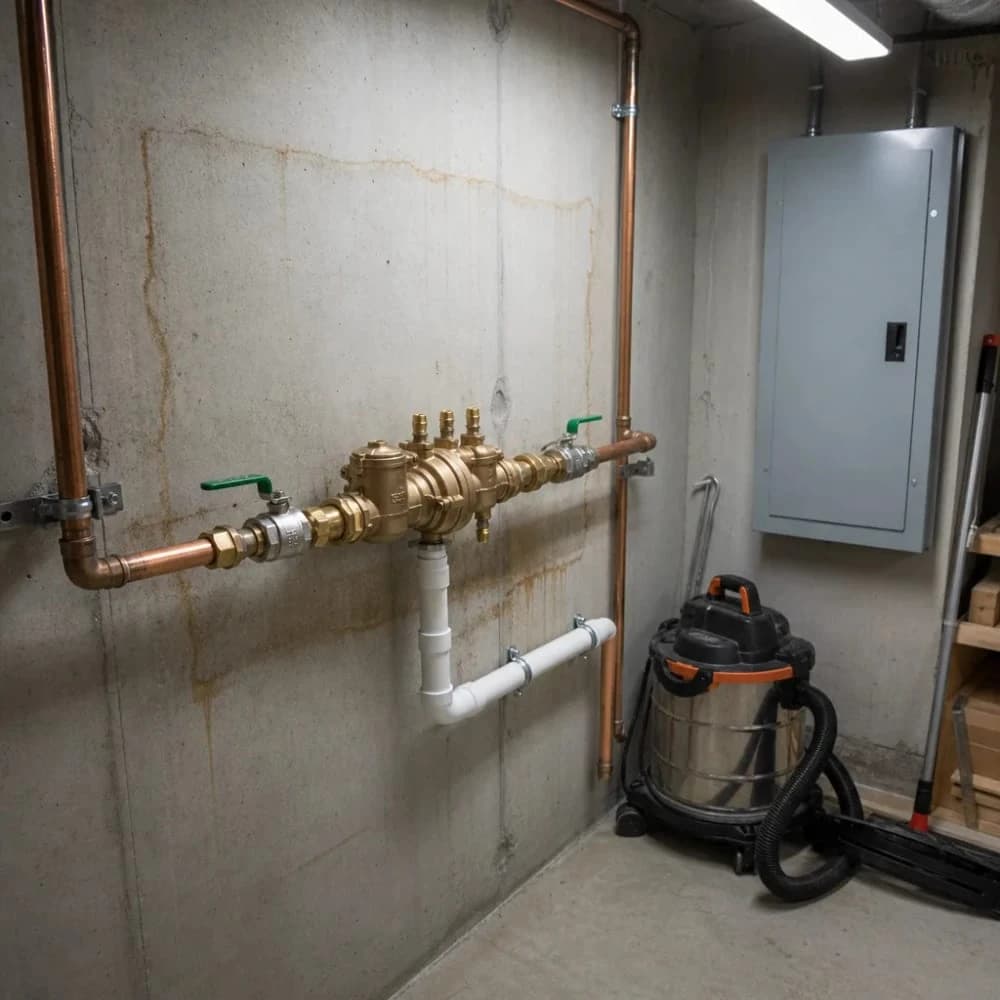
An RPZ has two check valves and a relief valve between them, and it is built to dump water from that relief port when something inside is not sealing. A steady drip or a gush from the relief port on an RPZ is a sign to test it, not something to plug.
Replacement beats another round of repairs in a few cases: a cracked body from freeze damage, parts that are no longer available for an older model, repeat failures after recent repairs, or a device that is the wrong type for a building that changed from a house to a business. If an older device passes and stays dry, age alone is not a reason to replace it.
Backflow Preventer Installation: Placement and the First Test
Backflow preventer installation comes up with a new sprinkler system, a new boiler, or a commercial kitchen tie-in. Indiana's plumbing code requires the owner to have the assembly tested at installation and again any time it is relocated, so a new device is tested before anyone counts on it.
Placement is set by code as well as convenience. Indiana requires at least 12 inches of clearance between the lowest part of the assembly and the grade, floor, or platform below it, and an indoor RPZ also needs a place for relief-valve water to go.

A new device can change how the whole system behaves. With a check valve or backflow device on the incoming line, the pressure that builds in a storage water heater as it heats has nowhere to go, and Indiana's code then calls for a way to control it, often an expansion tank. If every faucet runs at high pressure while the device tests fine, the pressure regulator is the part to look at instead.
If the service line is open for water line service anyway, that's the easiest time to ask whether a device belongs on it. A screw-on vacuum breaker at an outdoor faucet is a smaller fix, part of the everyday plumbing work in Evansville we do.
Common questions
- How often is backflow testing required in Evansville?
- Every year. Evansville's code (EMC 13.15) requires required devices to be tested and serviced annually, and Indiana's 327 IAC 8-10 requires a test at installation and at least once a year after. The result is filed with EWSU through Aqua Backflow.
- Can any plumber do a backflow test?
- No. Indiana requires the test to be done by a cross connection control device inspector who holds an IDEM registration number. Ask the tester for that number before the test starts.
- Does my home need a testable backflow preventer?
- It depends on what connects to your water line. EWSU lists sprinkler and irrigation systems, wet fire-protection lines, boilers, pools, and water features as the usual residential cases. A house with none of those, and no notice from EWSU or Aqua Backflow, usually has nothing due.
Where we do this work
This page is for backflow preventer test and install based out of Evansville, IN. We also work surrounding communities. City pages cover each market; as demand grows we can add service pages for specific cities without rebuilding this silo.
Related work
- Water Line & Service Install and Repair06
- Expansion tank install01
- Pressure regulator install/repair01
We also do this work for businesses across the area.
Commercial plumbingReady to Get Started?
Call (812) 677-8484 Now.