Pressure regulator install/repair in Evansville, IN
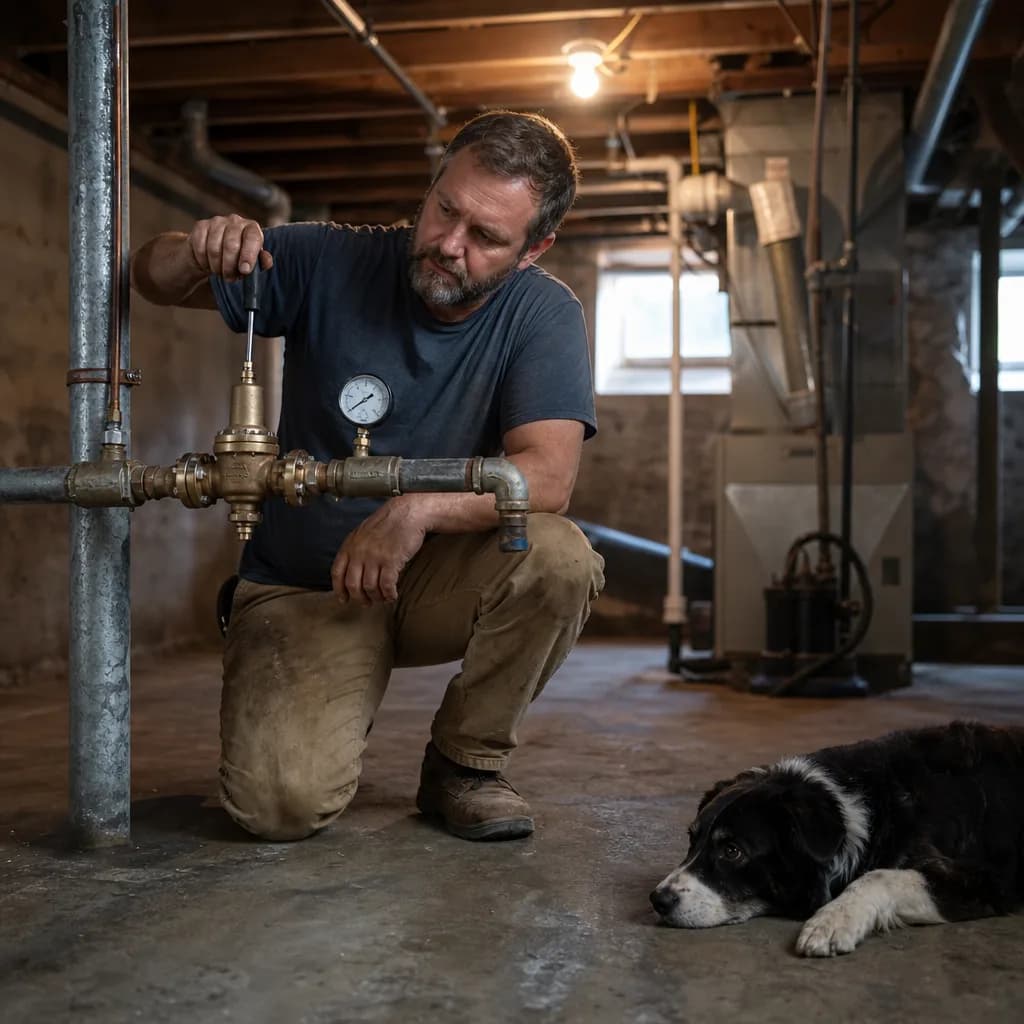
Your pressure regulator, the bell-shaped pressure reducing valve where the main comes into the house, feeds water to every faucet, toilet, and appliance. Pressure regulator install/repair starts with a gauge, not a guess, because the fix may be a turn of a screw, a rebuild kit, or a new valve. Trouble there often shows up as pipes that bang when the washer's done filling, faucets that spit when they first open, toilets that refill on their own, or weak flow at every fixture at once.
Water Pressure Regulator for a House: Whole-House Symptoms
A water pressure regulator for a house fails in a whole-house pattern, so when pressure is too high, too low, or swinging at every fixture at once, the regulator is the first place to look.
- Pipes hammer as a faucet closes or a washer valve snaps shut.
- Several faucets start dripping around the same time.
- Toilets run or refill when nobody has flushed.
- The water heater relief valve drips.
- Pressure is weak everywhere, or strong one hour and weak the next.
- A hum or whine comes from near the main line.
High pressure feels nice in the shower but pushes on every washer, valve, and hose all day, which is why several small leaks show up together. Indiana's commercial building code, at section 604.8, puts a pressure-reducing valve on any building whose static pressure tops 80 psi, and that's the usual line for a house too. EWSU designs its distribution system for a minimum of 35 psi static; what actually reaches a given street isn't published, so the only real number comes from a gauge at your own hose bib.
Banging gets its own code note. In Indiana's amendment, "an air chamber is not a water hammer arrestor," which means a capped stub of pipe in the wall won't cure hammer; correct pressure and, where needed, a real arrestor will.
Single-Fixture Problems Usually Aren't the Home Water Pressure Regulator
A home water pressure regulator can't make one sink weak and leave the rest alone. When one tap is the odd one out, the cause is at that tap or in its short supply line: a clogged aerator, a worn cartridge, a showerhead full of scale, a flapper or a fill valve out of adjustment, a partly closed stop, or clogged inlet screens on a washer. On USGS's hardness scale, Evansville's water is hard, about 138 ppm on EWSU's 2025 average, so scale in aerators and showerheads is a common single-fixture cause.
Weak hot water at every tap with strong cold water isn't the regulator either, since it feeds both sides; look at the water heater and the valves near it.
A pattern can still point back to pressure. Fix one fixture, and another fails a few weeks later, and the house may be telling you pressure is too high. Old galvanized supply lines that have narrowed inside can also make every fixture weak; that's a pipe problem, sometimes headed for a whole-home repipe, and a weak street-side line points to water line service.
How to Adjust Water Pressure Regulator Settings, Rebuild, or Replace
How to adjust water pressure regulator settings is a common search, and the first step is a reading. A gauge threads onto an outside spigot or laundry faucet and shows static pressure with nothing running. A gauge with a second, maximum-reading needle left on overnight catches spikes that a daytime reading misses.
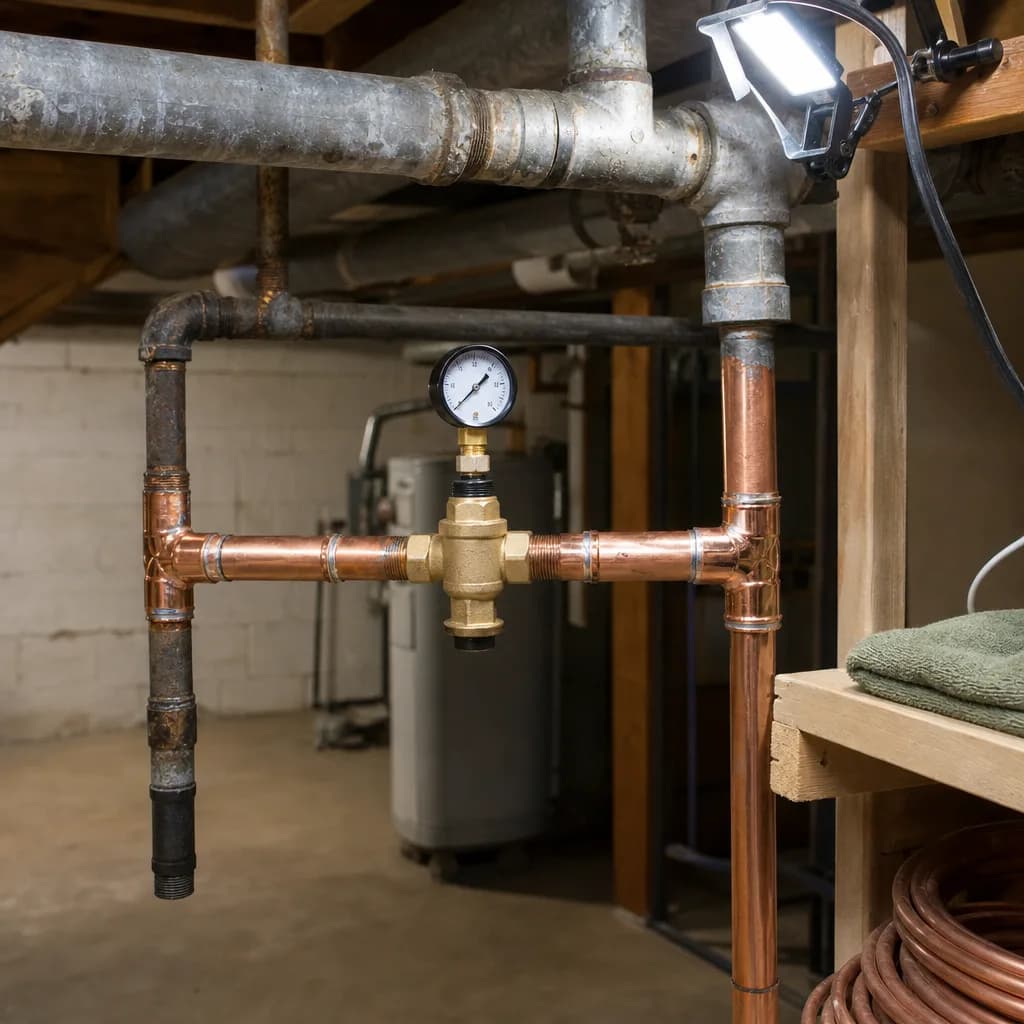
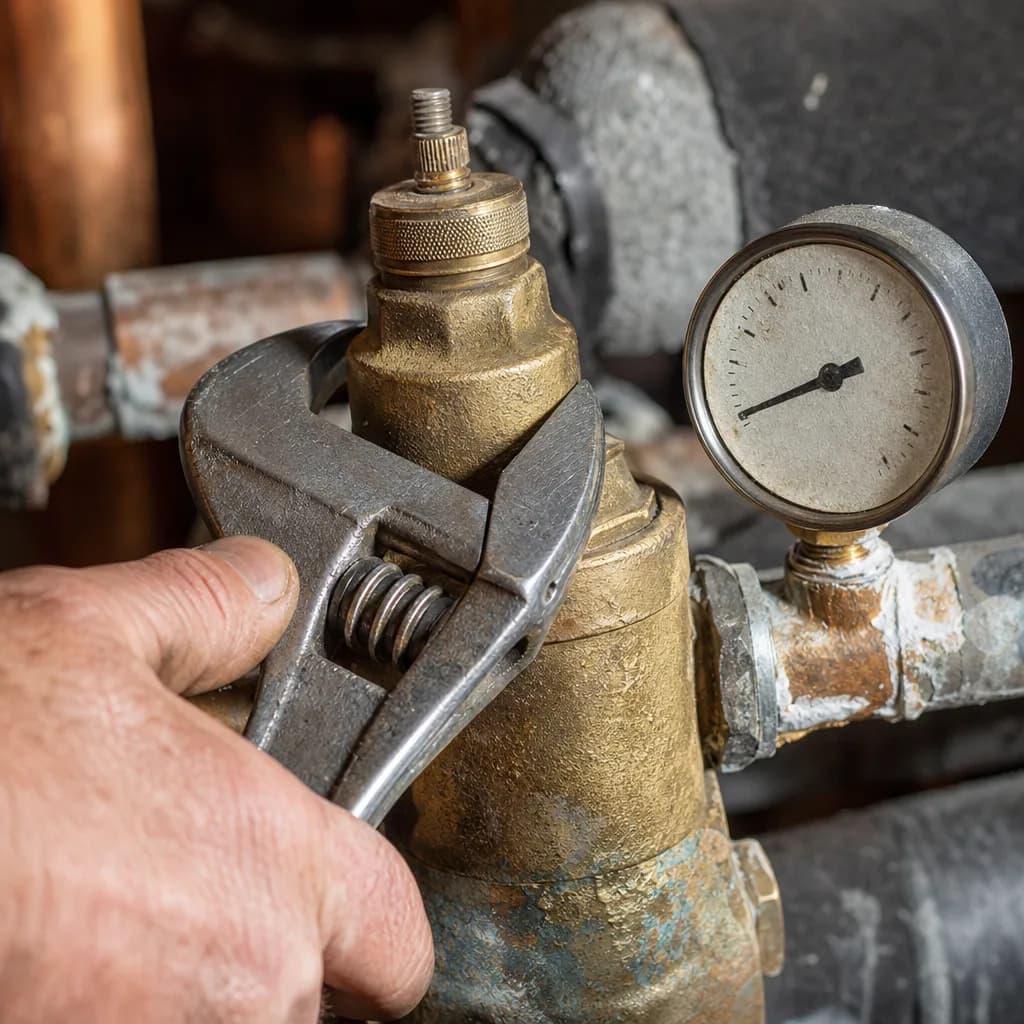
- Adjust. Most regulators have a screw under a cap; turning it changes the setting. It's a fix only when the valve is otherwise sound, and the gauge has to confirm the new number.
- Rebuild. A cartridge, diaphragm, or strainer screen can wear or clog; a kit can bring the valve back.
- Replace. A corroded body, seized fittings, or discontinued parts mean a new pressure reducing valve, usually with unions so it can be serviced later.
A rebuild or replacement means the main goes off and the lines drain. After the water is back, pressure is checked at the gauge and at the fixtures. A new regulator also traps heated water, so under the 2006 IPC text (section 607.3.1), services up to 2 inches need a pressure-control device when thermal expansion pushes downstream pressure above the regulator's setting. That's usually an expansion tank, sized and charged to the new pressure.
Water Pressure Regulator Replacement Cost Factors
Water pressure regulator replacement cost depends on which fix it needs and what's around the valve.
- Adjustment, rebuild, or replacement, which are very different amounts of work.
- Access, from an open basement to a low crawl space or a spot behind the water heater.
- Pipe size and material; commercial lines take a larger valve and more fitting work.
- The main shutoff, which may need replacing first if it won't close.
- Whether an expansion tank belongs on the same quote, which it usually does once a regulator closes the system under 2006 IPC 607.3.1.
A free quote on this job starts with a gauge reading, so an adjustment isn't sold as a replacement. Ask what the reading was, what the valve will be set to, and why adjust, rebuild, or replace.
A burst washer hose, a supply line spraying, or water pouring from the relief valve pipe is urgent: close the main shutoff and leave the regulator alone, since an old valve's fittings can be seized. A sudden leak is often the end of a slow pressure problem, so the reading still matters after the emergency is handled. Regulator work comes up regularly in plumbing in Evansville.
Common questions
- Can a plumber fix water pressure problems, or do I need to live with them?
- Most of them can be fixed. If every fixture is affected, adjusting, rebuilding, or replacing the regulator usually solves it, with a gauge confirming the result. EWSU designs mains for at least 35 psi static, so pressure that's weak everywhere often points to the regulator or narrowed pipe inside the house.
- What makes one regulator job cost more than another?
- The fix itself first: an adjustment is quick, a full replacement means a shutdown and new fittings. Access, pipe size, a main shutoff that won't close, and whether an expansion tank is needed under the thermal-expansion rule (2006 IPC 607.3.1) all change the price.
- Is it normal for a washing machine hose to burst from water pressure?
- High pressure is a common reason washer hoses, supply lines, and toilet lines fail early. Over 80 psi static, the commercial code Indiana adopted makes a regulator mandatory, and a house running that high is wearing out its hoses faster than it should.
Where we do this work
This page is for pressure regulator install/repair based out of Evansville, IN. We also work surrounding communities. City pages cover each market; as demand grows we can add service pages for specific cities without rebuilding this silo.
Related work
We also do this work for businesses across the area.
Commercial plumbingReady to Get Started?
Call (812) 677-8484 Now.