
Expansion tank install in Evansville, IN
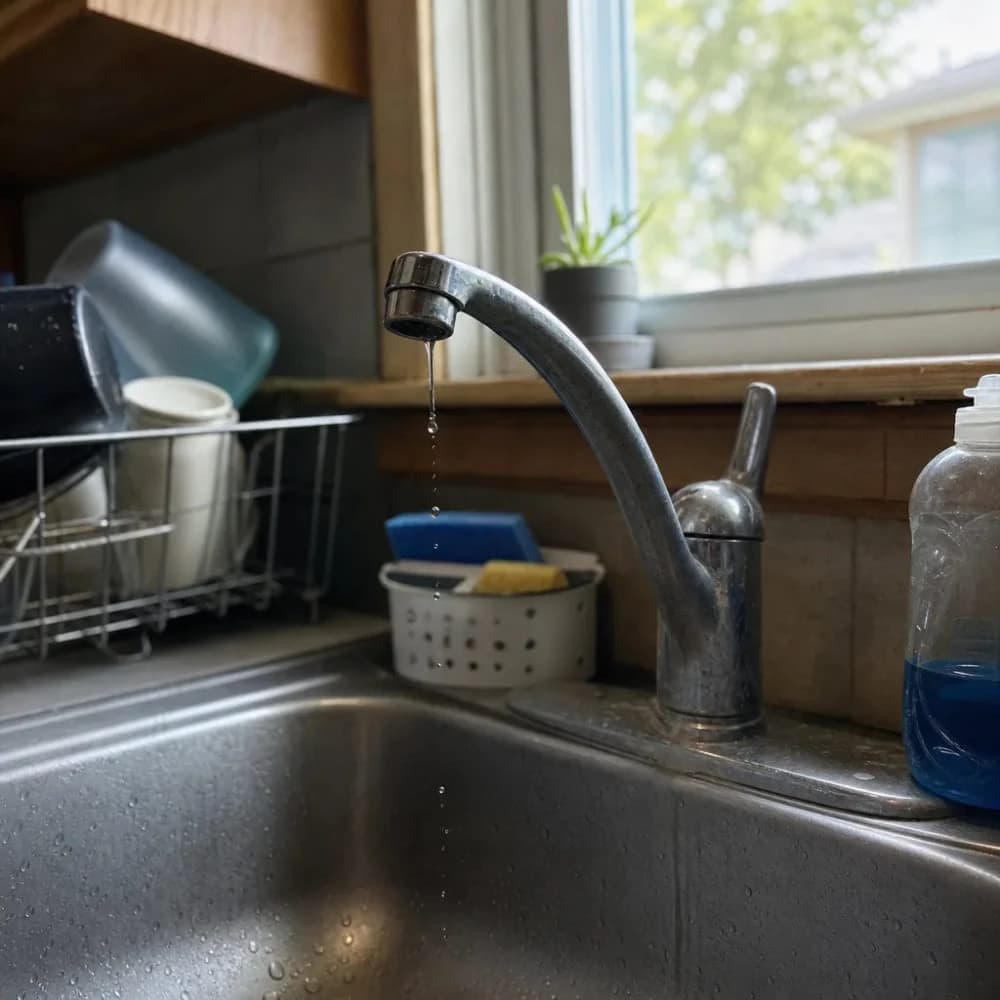
Expansion tank installs put a small steel shell on the cold supply at the water heater, with an air cushion behind a rubber bladder. The tank gives heated water room to grow when a check valve, backflow preventer, or pressure regulator keeps it from pushing back toward the street. Usually the signs are a relief valve dripping after each heating cycle, a toilet hissing for a second as the heater shuts off, or a faucet that surges when it first opens.
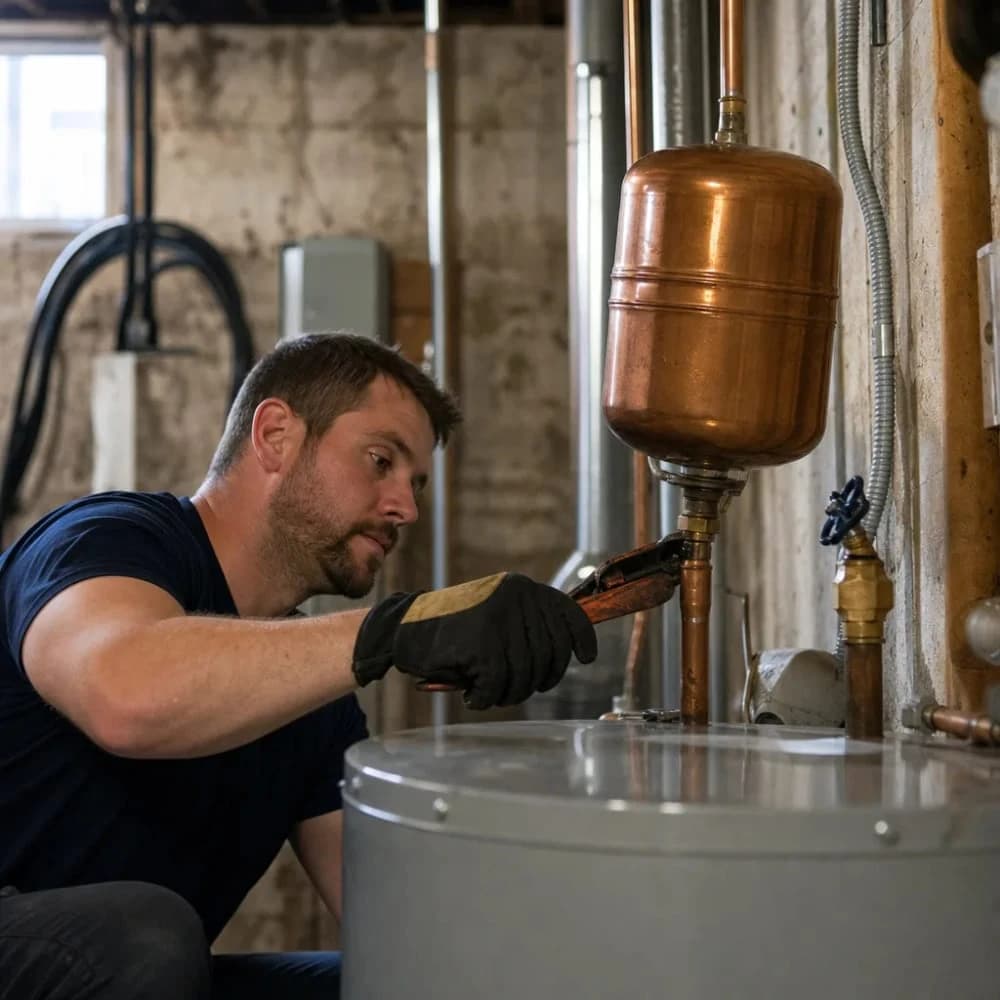
Why a Water Heater Needs Expansion Tank Installation in a Closed System
Thermal expansion is the reason for expansion tank installation. Water takes up more room as it heats and can't be squeezed smaller, so every time a storage heater warms a fresh tank of cold water, that extra volume needs somewhere to go.
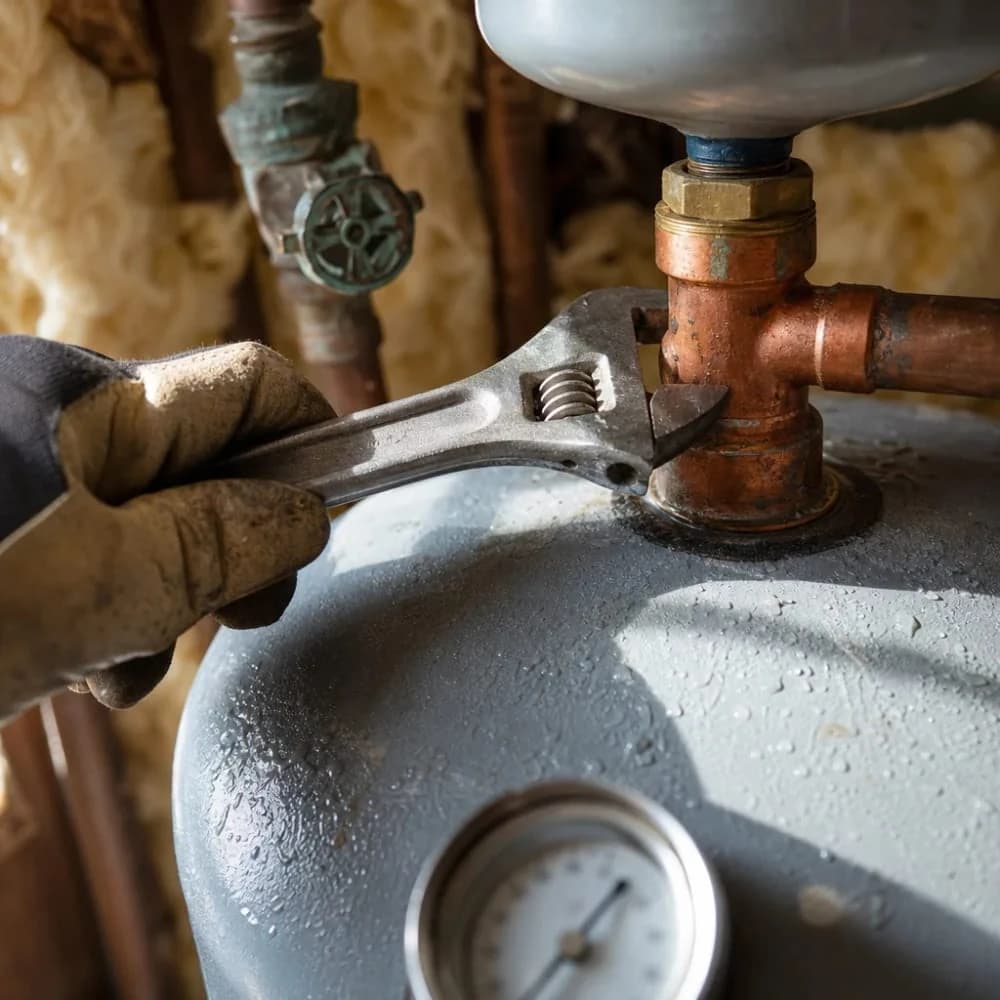
In an open system it backs out toward the main and nobody notices. In a closed system, a one-way part holds it in and pressure climbs until the relief valve lets go. Section 607.3.2 of Indiana's adopted 2006 IPC mandates a pressure-control device wherever a check valve or backflow device lets thermal expansion raise pressure on a storage water heater. Indiana's amendment to that section bars any valve on the pipe between a water heater and the expansion tank serving it.
Indiana also amends the rule for a bottom-fed water heater, or a tank tied to one, installed at or above the fixture outlets: it needs a check valve and a properly sized expansion tank, or a vacuum relief valve. Those sections cover commercial and multi-unit buildings, while houses answer to the 2020 Indiana Residential Code; there, the same no-valve-between-them layout is still the sound way to pipe it.
Repeated spikes wear on toilet fill valves, faucet cartridges, washer and dishwasher hoses, and the heater tank itself. A relief valve opening every day is doing its job, but it was never meant to be the pressure control.
Signs an Expansion Tank Install Has Failed
No expansion tank install lasts forever, and a failing tank gives no alarm; the usual sign is the relief valve dripping again after it had stayed dry.
- Tap the tank. A working one sounds hollow near the top; a failed one sounds solid all the way down and feels heavy.
- Water, not air, spits from the small air valve. That means the bladder tore, and the tank gets replaced.
- Rust, sweating, or a slow leak shows where the tank threads onto the tee.
A good tank can also be set wrong. Its air charge should equal the house's static pressure. Indiana's adopted commercial code (section 604.8) wants a pressure-reducing valve above 80 psi static, so if the pressure regulator was adjusted or replaced, the tank's charge may no longer match. A worn relief valve can drip on its own, too, so not every drip means a bad tank.
When You Can Skip Expansion Tank Installation
Expansion tank installation isn't needed where nothing on the line stops water from flowing back toward the main. Look where the main line enters, often a basement, a crawl space, or a utility closet, for a bell-shaped regulator or a backflow device on the cold side.
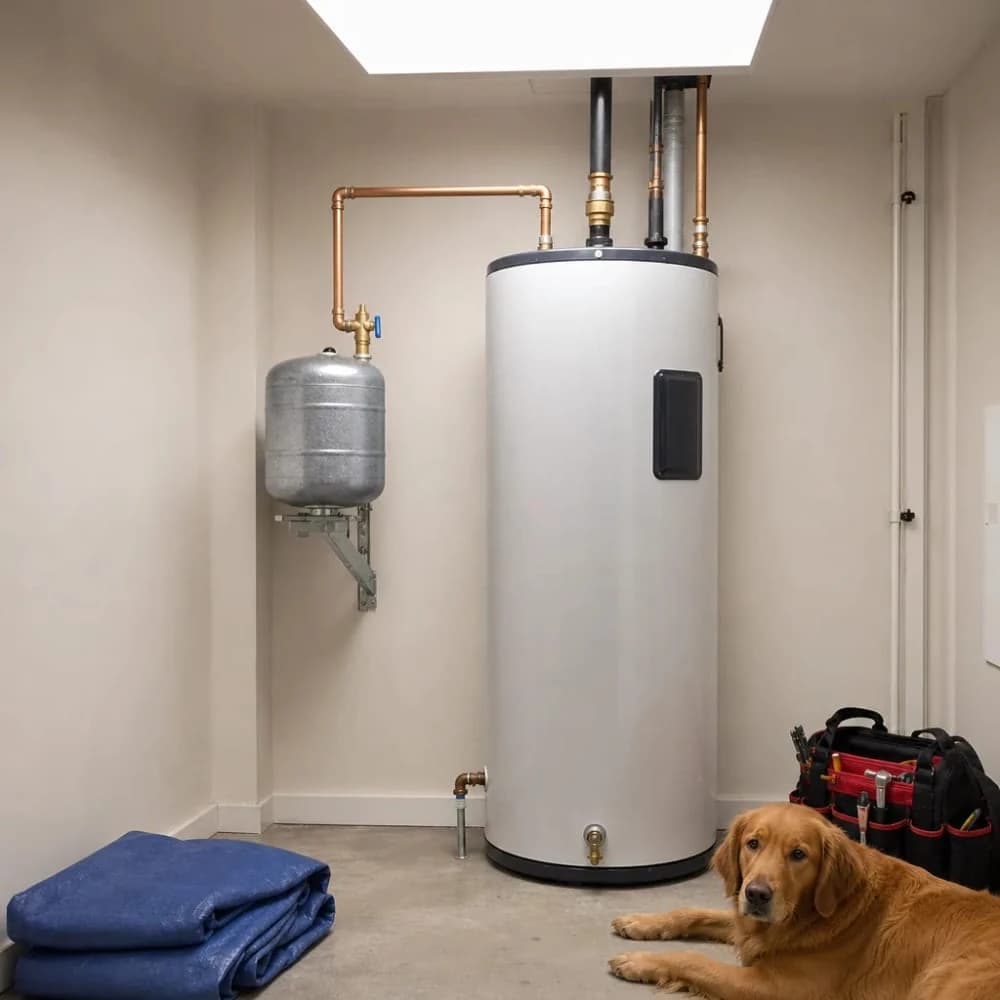
A one-way part isn't always visible, and EWSU's manual doesn't say whether residential meters carry one. A hose-bib pressure gauge isn't proof on its own, but it gives a useful second check: read it with no water running, then again while the heater is heating. A number that barely moves suggests the extra water has somewhere to go.
On many wells, the pressure tank after the pump check valve takes up that expansion when nothing one-way sits between that tank and the heater. A tankless heater holds little water, though some manufacturers still list a tank. A building with no storage heater on that line has nothing to expand. If the heater is old and the drip is small, the tank can go in with the water heater replacement.
Expansion Tank Installation and Replacement, Step by Step
An expansion tank installation or replacement takes part of a visit, with the water off for part of it and hot water down a little longer.
- The heater stops heating: gas control to off or pilot, or the breaker off on an electric heater.
- The main is shut and a faucet opened to bleed pressure.
- Static pressure is read, the tank is sized to the heater's gallons and that pressure, and the air charge is set to match before it goes on.
- A tee goes into the cold supply near the heater with no shutoff between tank and heater, and a strap holds the tank so its weight isn't on the pipe alone.
- Water comes back slowly, air is bled, joints are checked under pressure, and the heater runs a full cycle while the relief valve is watched.
The relief valve's discharge matters on the same visit. Under section 504.6 of Indiana's commercial code, T&P discharge can't connect straight to the drain and must end in an air gap in the same room, and that's good practice at home, too. Indiana's residential code waives the drain pan when the heater sits on a water-resistant floor that slopes to a floor drain in that room.
A bigger heater needs a bigger tank; one sized for a 40-gallon heater may be too small for a 50 or 75. A new backflow device is often what turns an open system into a closed one, so the tank belongs in the same plan as backflow preventer testing and install. Tanks are routine for any plumber in Evansville.
Common questions
- Does the expansion tank go on the hot side or the cold side of the water heater?
- The cold side, on a tee in the cold supply near the heater, with no shutoff between the tank and the heater. Indiana's amendment to the commercial plumbing code (607.3.2) spells out that no-valve rule, and it's the right layout in a house.
- What connections does a water heater expansion tank need?
- A tee in the cold supply, a short nipple, and a strap or bracket to carry the weight. Before installation, the air charge is set with a tire gauge to the static pressure in the house, so a 60 psi house gets a 60 psi charge rather than the factory setting.
- Is there a standard way expansion tanks should be installed, or does it vary by house?
- The steps stay the same; the sizing and charge change. Every install should start with a static pressure reading, then a tank sized to the heater's gallons and that pressure. Above 80 psi static, a regulator comes first; section 604.8 of Indiana's commercial code requires one there, and houses follow the same line.
Where we do this work
This page is for expansion tank install based out of Evansville, IN. We also work surrounding communities. City pages cover each market; as demand grows we can add service pages for specific cities without rebuilding this silo.
Related work
- Water Heater Installation and Replacement04
- Pressure regulator install/repair01
- Backflow preventer test and install01
We also do this work for businesses across the area.
Commercial plumbingReady to Get Started?
Call (812) 677-8484 Now.