
Sump Pump Repair in Evansville, IN
Sump pump repair in Evansville finds the failed part first so a new pump is not dropped into the same problem.
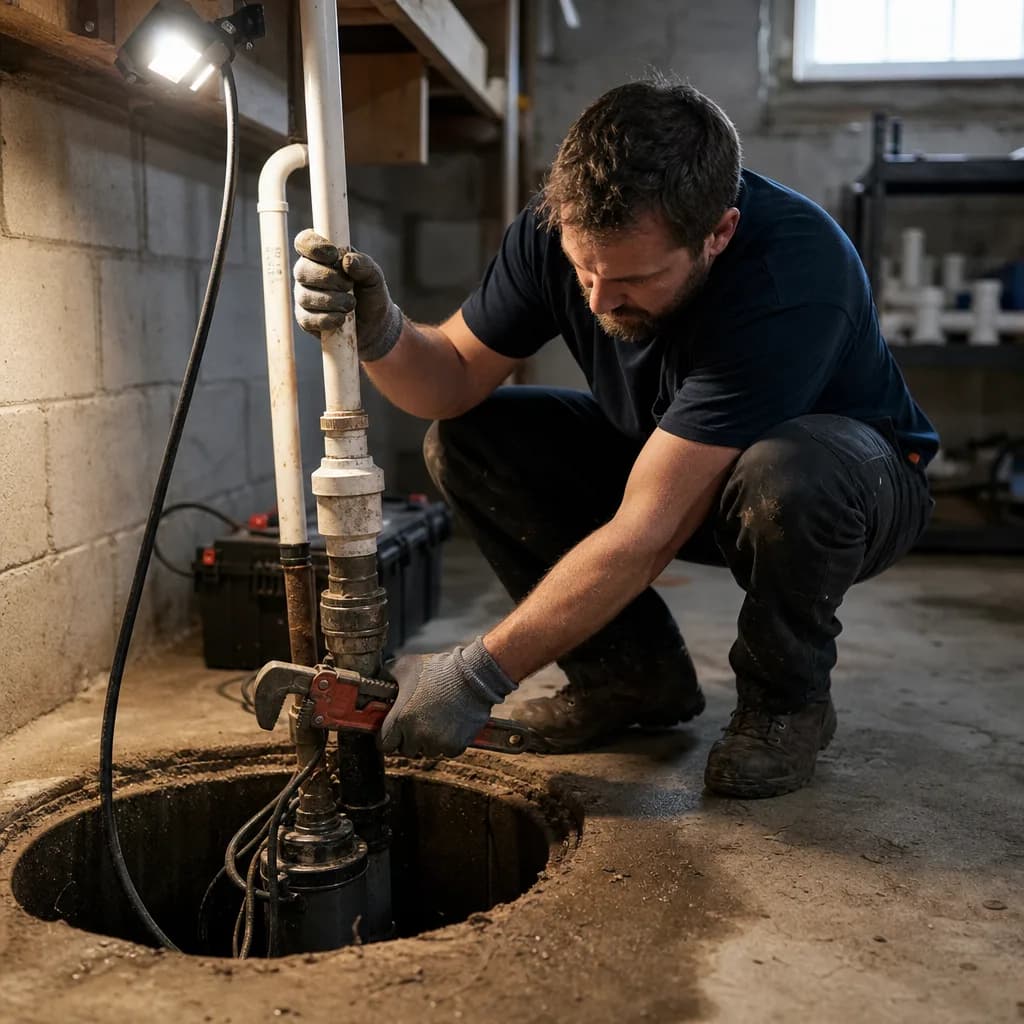
A pump that hums but does not lower the water, runs and will not shut off, kicks on every few seconds, or grinds and clunks usually needs sump pump repair before the next storm across Vanderburgh County. Sump pump repair in Evansville finds which part failed first — often past the motor — so a new pump is not dropped into the same problem, and at Evansville Plumbing Repair we take those calls around the clock across the Tri-State.
We're locally owned, with a 5.0 Google rating, and sump pump repair sits under our Drainage Service work — the same category that covers sump pump installation when the motor or pit is done, and crawl space and basement drains when water still has to be collected before it reaches the basin.
A basin or discharge line that needs its own rebuild after the pump is already sound is basin-and-line work, not this repair heading alone — and under EMC 13.05.070(A) that rebuilt path still cannot empty into the sanitary sewer.
Sump pump float switch
A sump pump float switch check comes first when the pit fills and the pump never starts, or when it runs without stopping — not when the motor already hums with a free float and a clear line after Hosmer soils have kept groundwater in the 1.5-to-2.5-foot winter table.
Before a paid repair visit, confirm power at the outlet, press reset on the GFCI if it tripped after a storm, and look for a breaker that opened. Shine a light in the pit: a float pinned against the wall, tangled in the cord, or buried in debris can keep the pump from starting or stopping even when NOAA's wet April average of 5.14 inches is loading the basin. Walk to where the discharge ends and clear leaves, mulch, or snow — City FAQ wants that line to a vegetated spot outside the road right-of-way (ROW), often ending at a pop-up valve. Then pour a bucket into the pit; a working pump should start, drain it, and shut off.
A GFCI that trips again and again means something is wrong with the pump, cord, or circuit, so stop resetting it. If the bucket test fails with power and float travel both fine, the simple float causes are ruled out and the next checks are the impeller, check valve, and discharge path under the same EMC 13.05.070(A) and EWSU discharge rules that ban a sanitary tie-in.
Sump pump check valve
A sump pump check valve repair is often enough when the pump short-cycles — starts, stops, and starts again every few seconds — because water falls back into the pit after each run instead of staying in the discharge line that must stay off the sanitary sewer under EMC 13.05.070(A).
That is still path work, not a brand-new system. A clogged, crushed, or sagging discharge line makes the motor strain every cycle; a line that empties beside the house lets water soak back toward the pit; a pit that is too small short-cycles the pump even with a sound valve. For Class 1 buildings, Indiana's plumbing code text sets an 18-by-24-inch pit (18 inches across and 24 inches deep) as the smallest size without special approval — a sensible minimum we use as a guide in a house as well, not an invented residential-only rule beyond that guide, and Indiana also bars AAVs from venting sump pits.
When EWSU and City rules ban sending sump discharge into the sanitary sewer under EMC 13.05.070(A), a failed outdoor routing problem is still a discharge fix, not a reason to invent a sanitary tie-in. If a pump has already been replaced once and the same short-cycle came back after NOAA's 5.14-inch April average, something else in the path is doing the damage.
Sump pump repair
Sump pump repair is the job that matches the failed part — float, impeller, check valve, clearable line, or power path — when the pit and overall system can stay, rather than a full sump pump installation or sump pump replacement after long runs on Vanderburgh County soils.
Repair calls here follow the soil and the rain. USDA's soil survey describes Hosmer soils, which dominate the county's uplands, as having a perched seasonal water table 1.5 to 2.5 feet deep, December through April, in most years. On the Ohio River bottom lands, the Wakeland-Stendal-Birds association (about 9% of the county) is somewhat poorly to poorly drained, and Wakeland's water table reaches 0.5 to 1.5 feet from November through May in undrained areas. NOAA's 1991–2020 normals for Evansville Regional Airport put April and May at 5.14 and 5.12 inches — the two wettest months — so long spring run times wear every part, not just the motor.
Evansville's levee, approved after the 1937 flood, includes 20 pumping stations and keeps the river out of the sewer system, but private pits still do the work on private lots. When water is pooling under the slab or along the foundation while the pit stays low, that points to French drain / exterior drainage or exterior drain repair, not a motor swap. City of Evansville engineering handles drainage only inside easements or the road right-of-way; drainage on your own lot stays with you.
A free quote names the failed part before anything gets swapped; there's no trip or diagnostic fee. We're open 24/7 for sump pump repair across Evansville and the Tri-State. Call (812) 677-8484 when you're ready.
Common questions
- Is this the same as sump pump installation?
- Sump pump installation covers a new system, a new or rebuilt pit, or a full sump pump replacement when the motor or basin is done. Sump pump repair settles float, check valve, impeller, power, and clearable discharge faults when the system can stay under EMC 13.05.070(A) discharge rules. Use installation when the pump or pit itself needs to be replaced; use this page when a part repair is enough.
- Who handles drainage outside my property line?
- The sump system and drainage on your own lot are yours. City of Evansville engineering handles drainage problems only within drainage easements or the road right-of-way, so a blocked city drain there goes to the City.
- Can a sump pump handle yard, roof, or patio storm water by itself?
- No. A sump pump moves only water that reaches the pit. Surface water needs grading, gutters, or a yard drain, and EMC 13.05.070(A) bars that runoff from the sanitary sewer — EWSU lists sump pumps among illegal sanitary connections.
- Do I need a new pump if I live near the Ohio River?
- Often a working pump helps if the basement takes on water. Bottom-land Wakeland soils near the river can hold water within 0.5 to 1.5 feet of the surface from November through May in undrained areas, per USDA. The levee approved after the 1937 flood, with 20 pumping stations, stops the river backing into the sewers, yet wet soils and rainfall still reach private basements — that is lot-side sump work, not a claim that the river pushes groundwater "from below" as a sourced mechanism.
- Is grinding always a failed motor?
- Not always. Grinding, rattling, or a hard thud at shutoff can be worn bearings, a damaged impeller, or a check valve slamming after a season of Hosmer water-table runs. We check the float, valve, and discharge path before assuming the only fix is a full replacement.
Ready to Get Started?
Call (812) 677-8484 Now.