
Well pump and pressure tank in Evansville, IN
A well pump and pressure tank only matter if the water comes from a private well. The pump pulls water up; the tank stores some under pressure so the pump doesn't start at every faucet. In Vanderburgh County, USGS estimated that in 2015 about 12,550 residents, or roughly 6.9% of 181,877, were on self-supplied groundwater. Everyone else pays a water bill, and their pressure problem is somewhere else.
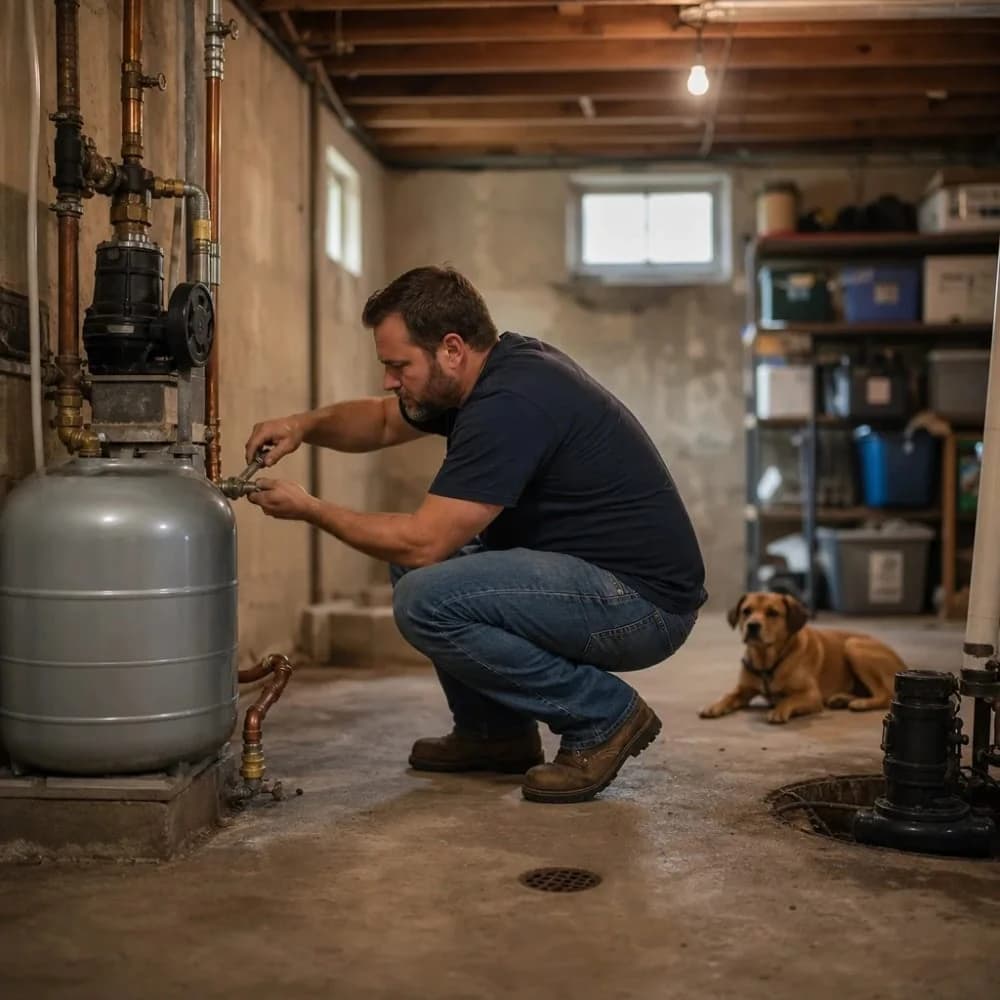
Well Pump and Pressure Tank or City Water? Confirm the Source
This work starts with one check: is there a well at all?
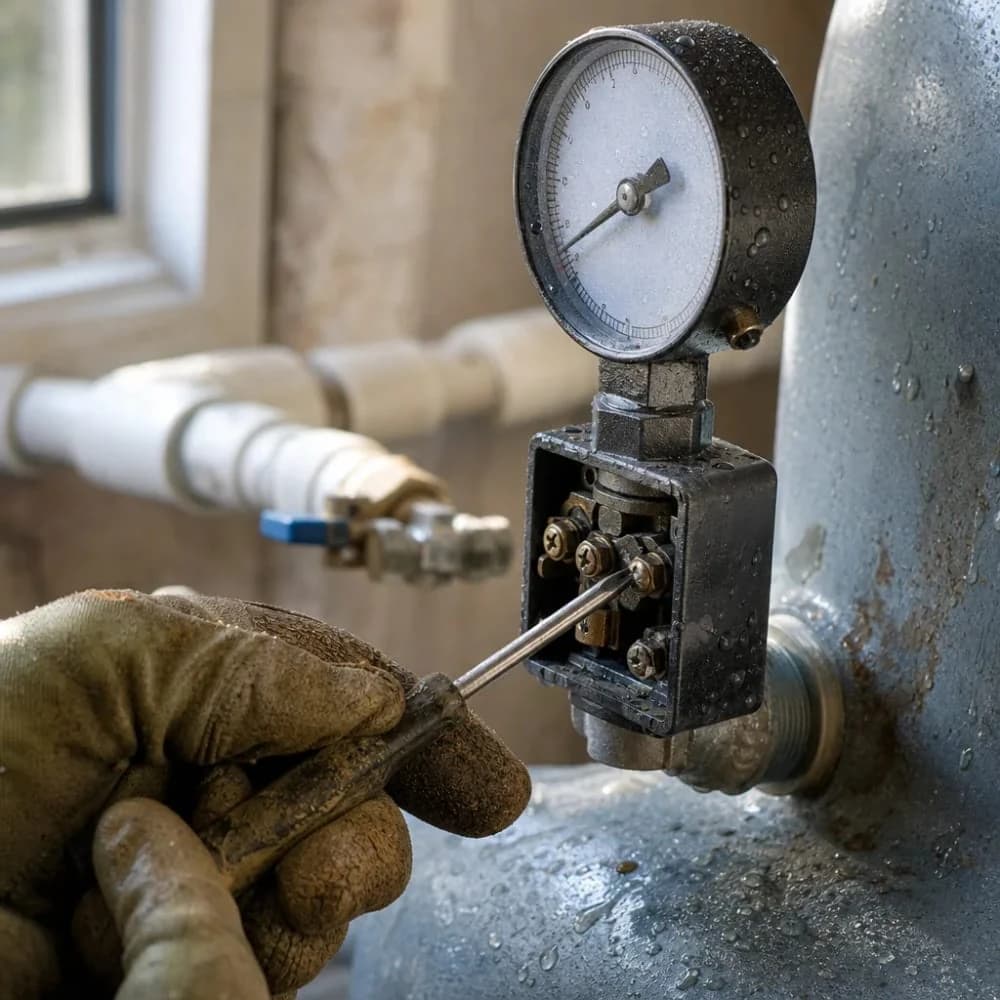
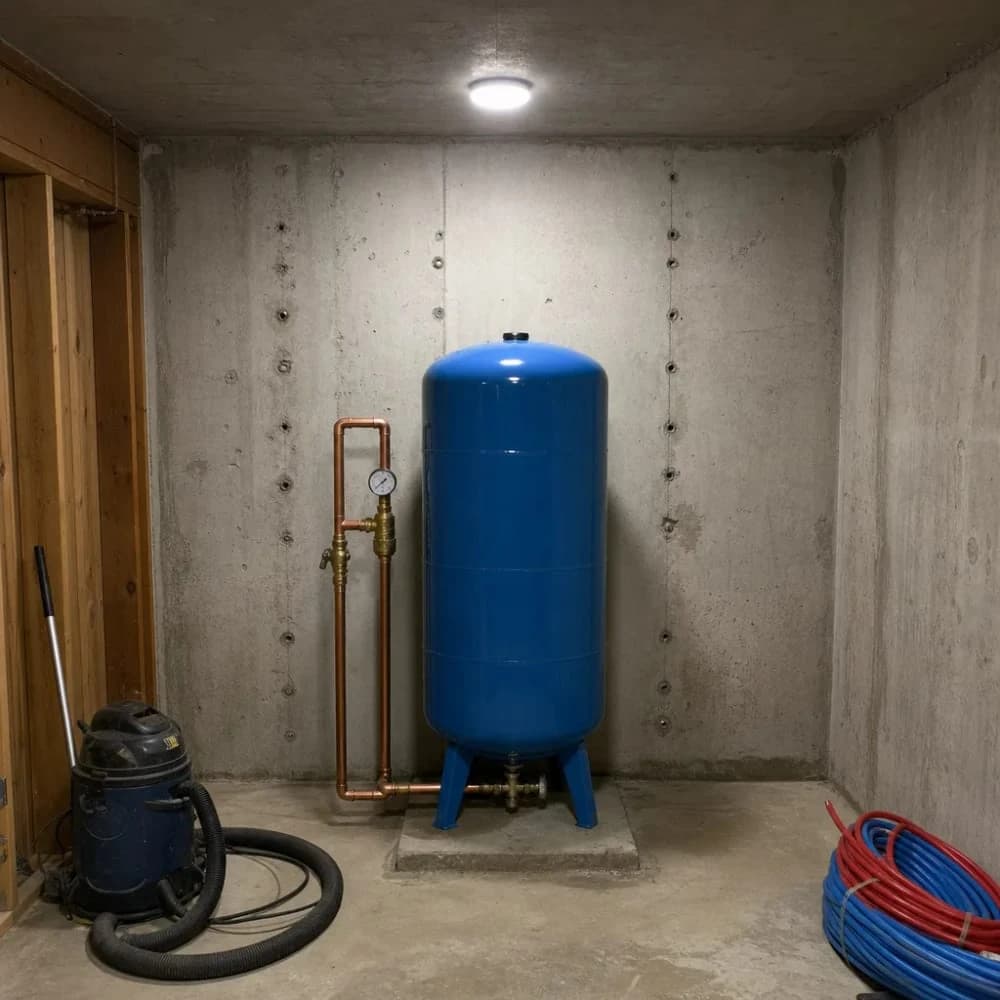
A private well usually means no water bill, a capped pipe in the yard with a metal or plastic lid, a tall tank near where the water line enters with a gauge and a switch box, and no new water once the power is out and the tank runs dry. City water means a bill from the utility, a meter in a pit near the street or inside, and faucets that still run during an outage. EWSU's meter sits in an outside pit the owner maintains, and only EWSU may turn it on or off.
A tank next to the water heater isn't a well tank. That's the heater itself, or an expansion tank on its cold line. On city water, weak or uneven pressure points to a pressure regulator, a leak, or the service line. Some properties switched to city water and left the old well in place, or use a well for a barn while the house is on the utility. Vanderburgh County hasn't adopted a well ordinance, and its health department lab runs total coliform tests on water from private wells.
Well Pump Replacement or Well Pump Repair?
Well pump replacement and well pump repair are different jobs, and the clues usually sort them.
It's probably the tank when the pump restarts every few seconds while a faucet runs, the gauge needle jumps fast, water pulses at the tap, or the tank rusts, sweats heavily, or leaks at the seams; that's a waterlogged tank whose air cushion has given out. It's probably the pump when power is on but there's no water and the pump never starts, the pump never shuts off with every faucet closed, pressure falls and never recovers, the water brings up sand or grit, or the breaker keeps tripping. A pressure switch that's worn, a clogged fitting, or a loose wire can mimic a dead pump, and that's a smaller fix. Pulling a submersible pump is the big job here, since wells in the county's Ohio River aquifer are commonly 45 to 85 feet deep.
Leave a tank short cycling and the pump motor wears out, so a tank problem can end up ruining the pump. A new tank won't restore pressure if the pump is worn out. If only the hot water is weak or rusty and the cold runs fine, the well isn't the cause. A leaking tank that a new fitting can save belongs under water tank repair, while a new tank calls for water tank installation.
Well Pressure Tank Replacement and Short Cycling
Once a tank has gone waterlogged, with its air cushion gone, well pressure tank replacement is normally the fix. Set the new tank's air charge to agree with the pressure switch's settings, or the pump will be short cycling again on day one. Indiana DNR's guidance says the state's well rules don't regulate pressure tanks inside the building, so the tank swap is ordinary plumbing rather than well-driller work.
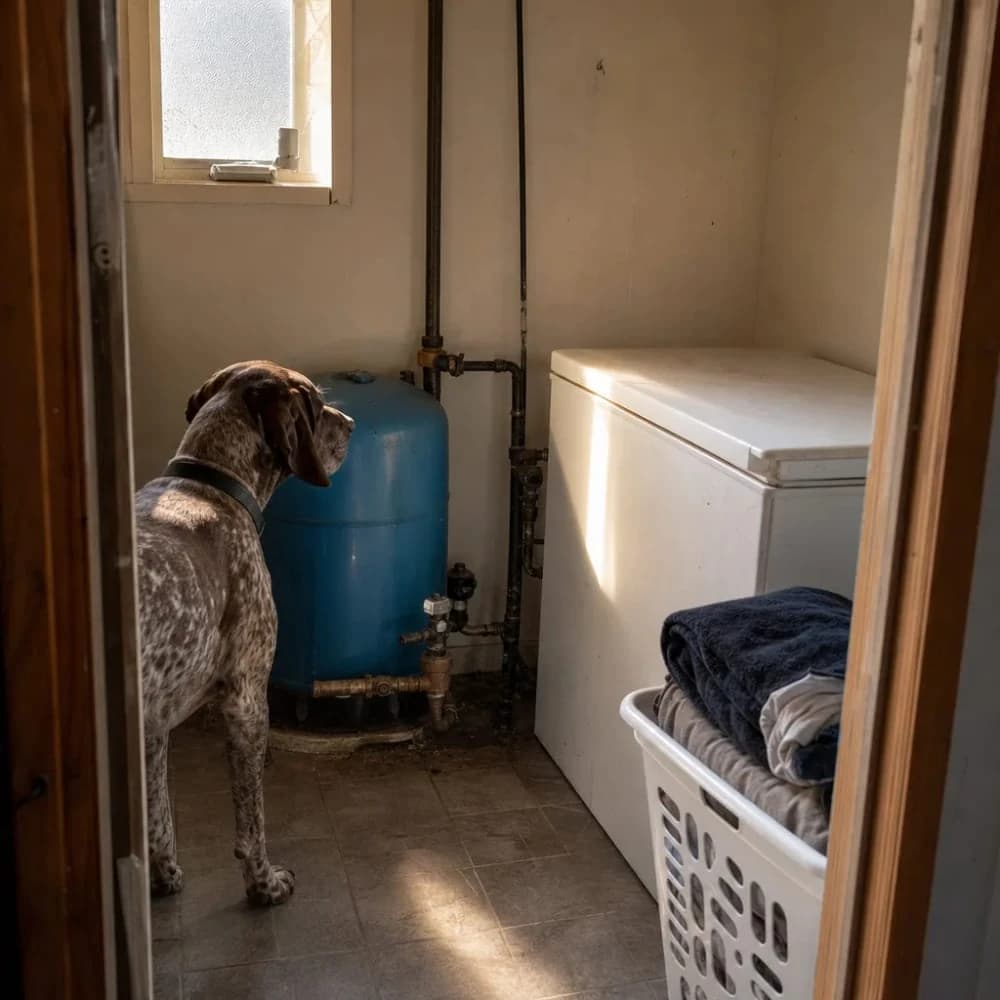
Treat it as urgent when there's power but no water anywhere, the pump runs nonstop with every tap closed and risks burning out, water is pouring from the tank or a fitting and soaking the basement, or the breaker trips again after a reset or you smell something hot. For a business on a well, no water means restrooms and sinks are down. It can wait when pressure has faded slowly but water still flows, short cycling is mild and nothing leaks, or the tank looks rusty but isn't dripping. A neighborhood-wide power outage isn't a well failure at all. A private well that went quiet overnight, with nothing at the tap, is a reason to phone (812) 677-8484.
Freeze Protection for the Well Pump and Pressure Tank
A well pump and pressure tank survive winter fine below ground; the trouble is the parts above it. NOAA's 1991–2020 normals count 90.4 nights a year at or below 32°F at Evansville Regional Airport, with an average January low of 25.5°F.
The pressure switch, along with the small tube feeding it, freezes first, because they hold so little water, and a frozen tube makes the pump look dead: it won't start, or it won't stop. The pipe from the wellhead through a crawl space, a tank in a pump house or barn, and outdoor lines to a shop or animal waterer are the other weak spots. Insulation on exposed pipe, closed crawl-space vents, and a pump-house door that shuts help. If the tank sits somewhere that drops below freezing every winter, moving it into a heated space is the lasting fix. Once a fitting thaws, look for the split the ice made; a line that burst inside the house needs pipe repair.
What Drives Well Pump and Pressure Tank Cost
Well pump and pressure tank cost depends first on which part failed.
- Pump type. A pump above ground in a basement or pump house is reachable. One deep in the well has to be pulled up with its pipe and wire.
- Depth. Wells in the Ohio River outwash aquifer, the county's most productive, are commonly 45 to 85 feet deep. Indiana's well rule says a pump in an unconsolidated sand or gravel aquifer must provide at least 20 feet of available drawdown, which is why depth matters to the job and isn't just a number.
- Tank size. A bigger tank costs more and lets the pump rest longer between starts.
- Access, related parts like the switch, gauge, and check valve, and damage from a freeze or a pump that ran dry.
There's no trip fee to learn whether the tank, the switch, or the pump failed. The pump in the well falls under Indiana DNR's well rules, while the pressure tank and the piping between the well and the house don't. Wells belong to plumbing in Evansville too.
Common questions
- How long does a well pressure tank usually last?
- Several years, depending on how hard the pump works. A tank that short cycles wears out faster because it's losing its air cushion and forcing the pump to start constantly. In a county where only about 6.9% of residents were on wells in 2015, most tanks are older ones on long-standing wells.
- Can I replace my own well pressure tank?
- The DNR's well rules don't regulate pressure tanks inside the building, so the tank itself isn't covered by Indiana's well statute (IC 25-39). Setting the wrong air pressure still leaves the pump short cycling, while the piping and wiring between the well and the house are ordinary plumbing and electrical work.
- What makes a well pump or tank replacement cost more?
- Pump setup, well depth, and access. Pulling a pump from a well that's commonly 45 to 85 feet deep in the Ohio River aquifer takes more labor than swapping a tank in an open basement, and the 20-foot drawdown rule shapes how the replacement pump is set.
Where we do this work
This page is for well pump and pressure tank based out of Evansville, IN. We also work surrounding communities. City pages cover each market; as demand grows we can add service pages for specific cities without rebuilding this silo.
Related work
We also do this work for businesses across the area.
Commercial plumbingReady to Get Started?
Call (812) 677-8484 Now.